
 English
  русский
  中文简体
中文简体 



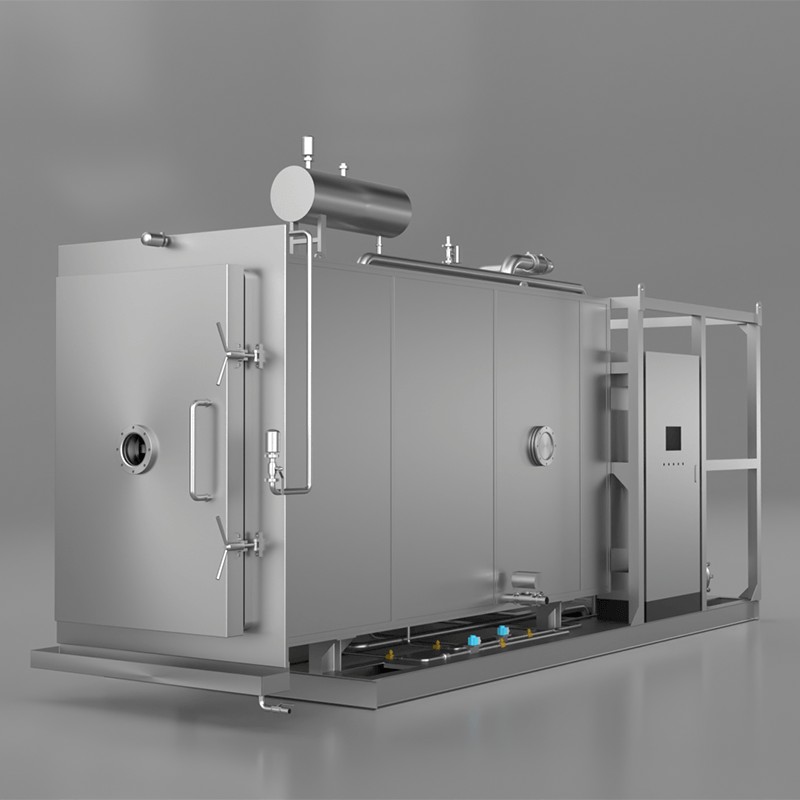
What is the role of Freeze-Drying Equipment for Nanomaterials in the production of nanomaterials?
Freeze-Drying Equipment for Nanomaterials plays a vital role in the production of nanomaterials, especially in maintaining the physical and chemical properties of nanomaterials, improving product stability, and ensuring the high performance of materials. Freeze drying is a process of sublimating solvents at low temperature and vacuum, which can effectively remove water and solvents without destroying the fine structure of nanomaterials. Compared with traditional thermal drying methods, freeze drying technology can significantly reduce the impact of high temperature on materials and avoid possible oxidation, agglomeration or degradation.
(1) Avoiding degradation of heat-sensitive materials
Many nanomaterials, especially nanometals, nanooxides, nanocarbon materials, etc., have strong thermal sensitivity. Traditional thermal drying methods are prone to reduce the performance of these materials due to high temperatures. For example, the activity of nanometal catalysts may decrease at high temperatures, and the surface activity of nanocarbon materials may also be destroyed. Using Freeze-Drying Equipment for Nanomaterials, water or solvents can be sublimated under low temperature and vacuum conditions to ensure that the activity and structural integrity of nanomaterials are not damaged, thereby effectively improving their performance in various applications.
(2) Improving the stability and dispersibility of nanomaterials
Freeze-Drying Equipment for Nanomaterials can effectively remove solvents, reduce agglomeration, and help nanomaterials maintain a good dispersion state after drying. This is very important for many applications of nanomaterials because the uniform dispersion of particles determines their catalytic, drug delivery and other functions. Freeze-dried nanomaterials usually do not show crystallization or agglomeration, which means that they can maintain high activity and efficiency in subsequent production and applications.
(3) Solving the problem of solvent residue
Solvent residues may have a negative impact on the application of nanomaterials, especially in nanodrug carriers or nanofoods. Freeze-Drying Equipment for Nanomaterials can completely remove these solvents, avoiding the solvent residue problem that may be caused by traditional drying methods, thereby ensuring the safety and functionality of nanomaterials.
(4) Improving production efficiency and scale
For large-scale production, freeze-drying equipment can provide higher production efficiency. By precisely controlling temperature, pressure, and sublimation rate, Freeze-Drying Equipment for Nanomaterials can ensure batch-to-batch consistency and achieve efficient and stable production. This is crucial for industrial production processes and can significantly reduce production costs and enhance the competitiveness of enterprises.
How does Freeze-Drying Equipment for Nanomaterials adapt to different types of nanomaterials?
Different types of nanomaterials have different chemical properties, physical characteristics, and application requirements. Therefore, when using Freeze-Drying Equipment for Nanomaterials, the equipment parameters must be adjusted according to the characteristics of the specific material. This includes sublimation temperature, heating rate, vacuum level, etc., to ensure that the nanomaterials do not agglomerate, crystallize, or degrade during the drying process.
(1) Metal Nanoparticles
Metal nanoparticles (such as nanogold, nanosilver, etc.) have strong surface activity and easily react with oxygen in the air, resulting in oxidation. When using Freeze-Drying Equipment for Nanomaterials, it is necessary to ensure that the equipment is operated in an inert gas atmosphere (such as nitrogen or argon) to avoid oxidation of the metal nanoparticles. The freeze-drying process also requires precise control of temperature and sublimation rate to avoid aggregation and morphological changes of metal particles.
(2) Nanocarbon materials
Nanocarbon materials, such as carbon nanotubes and graphene, are widely used in electronics, energy storage and other fields. During the drying process of these materials, it is necessary to avoid aggregation or agglomeration between particles, which may affect their specific surface area and conductivity. When processing carbon-based materials, Freeze-Drying Equipment for Nanomaterials can ensure that the dispersion and surface properties of their particles are not affected by precisely controlling the freezing, heating and sublimation rates. In this way, the freeze-dried nanocarbon materials will have better performance and stability.
(3) Nanooxides
Nanooxides (such as titanium oxide, zinc oxide, etc.) are usually prone to crystallization or morphological changes at high temperatures, affecting their catalytic and photoelectric functions. Freeze-Drying Equipment for Nanomaterials can gently remove solvents at low temperatures, thereby avoiding the occurrence of crystallization. When processing these nanooxides, the temperature control and vacuum regulation of the equipment are particularly critical. Only precise parameter control can maintain the structural stability of the nanomaterials.
(4) Nano drug carriers
Nano drug carriers are usually composed of polymers, lipids or other biocompatible materials, which are very sensitive to temperature. Freeze-Drying Equipment for Nanomaterials can remove solvents at low temperatures, avoiding the damage to the drug carrier structure caused by high-temperature drying, ensuring its biocompatibility and drug delivery efficiency. This is particularly important in the field of nanomedicine, because the stability and activity of drug carriers directly affect the efficacy of drugs.
(5) Nanocomposites
Nanocomposites are usually composed of nanoparticles and polymer matrices. During the freeze-drying process, it is necessary to ensure uniform dispersion between the nanoparticles and the matrix in the composite material to avoid agglomeration or degradation between the particles. By precisely controlling the temperature, pressure and other parameters during the freeze-drying process, Freeze-Drying Equipment for Nanomaterials can provide ideal drying conditions for the composite material, ensuring the stability of its performance in various applications.
Providing customized solutions based on customer needs
Sieno Freeze-drying Technology Research Institute (Jiangsu) Co., Ltd. pays special attention to the design and implementation of customized solutions when providing freeze-drying equipment to customers. Combining the company's rich experience and professional technical team, Sieno Freeze-drying Technology Research Institute (Jiangsu) Co., Ltd. can provide tailor-made production equipment, layout solutions and related technical support according to the needs of different customers.
(1) Personalized demand analysis and customized design
Sieno Freeze-drying Technology Research Institute (Jiangsu) Co., Ltd.'s technical team has 10 years of experience in freeze-drying equipment research and development and production. From the beginning of the project, we can provide personalized analysis and customization based on the specific needs of each customer. Whether it is a production line of different sizes or a product of different types (such as food, medicine, pet food or nanomaterials), Sieno Freeze-drying Technology Research Institute (Jiangsu) Co., Ltd. can provide the most suitable solution based on the customer's product characteristics, production requirements, space layout and other needs. Through customized design, we ensure that the customer's production efficiency is maximized and the equipment performance is optimized.
(2) Complete technical support and service system
When providing customized freeze-drying equipment, Sieno Freeze-drying Technology Research Institute (Jiangsu) Co., Ltd. ensures that the entire process from preliminary planning to equipment installation, commissioning and final delivery is completed by an in-house professional team. This not only allows for better control of product quality, but also ensures more efficient delivery and more controllable service. Each device undergoes rigorous factory testing and commissioning to ensure that it can run smoothly when used by the customer, reducing downtime and improving the overall efficiency of the production line.
(3) Production layout and process test sample provision
In addition to the customization of the equipment itself, Sieno Freeze-drying Technology Research Institute (Jiangsu) Co., Ltd also provides complete production layout solutions and process test samples. Through in-depth communication with customers, Sieno Freeze-drying Technology Research Institute (Jiangsu) Co., Ltd is able to provide comprehensive factory layout suggestions to help customers better plan production lines and verify the feasibility and effectiveness of the process through small-scale process test samples. These solutions and samples provide customers with great flexibility, helping them ensure that every link in the production process can be implemented smoothly.
(4) Adaptability to diverse freeze-drying needs
Sieno Freeze-drying Technology Research Institute (Jiangsu) Co., Ltd's freeze-drying equipment design not only covers large-scale production needs from home-based to industrial-grade, but can also be adjusted accordingly to meet the needs of different industries. Whether for small-batch R&D or large-scale industrial production, Sieno Freeze-drying Technology Research Institute (Jiangsu) Co., Ltd. provides the appropriate equipment and support to meet the needs of production lines of varying sizes and types.
Combining Sieno Freeze-drying Technology Research Institute (Jiangsu) Co., Ltd.'s company information reveals that the company maintains a high level of professionalism and flexibility in providing customized freeze-drying solutions, helping clients maximize production efficiency and technological innovation.


 +86-180 6875 7376
  +86- (0) 519-8578 6988
  emmy@jsblk.com
  Zhenglu Town, Tianning District, Changzhou City, Jiangsu Province, China