English
 русский
 中文简体

Request a Quote

Industry News
 Home / Recent News / Industry News / How Much Vacuum Is Needed for Freeze Drying? Key Ranges and Practical Tips
 2026.10.27
 Industry News
If you are setting up a freeze dryer for the first time, “how much vacuum is needed for freeze drying?” is usually one of the first questions. The direct answer is that most freeze-drying processes run with a chamber pressure between 0.05 mbar and 0.3 mbar. That range works for many food products, biological materials, and laboratory samples, but the ideal setpoint depends on the product’s temperature, structure, and residual moisture target. Let’s walk through what those numbers mean and how to choose a practical vacuum level for your process.
Vacuum is not what freezes the product; it is what allows the ice to leave. During freezing, water is turned into ice crystals. Once the chamber is evacuated, those ice crystals can sublimate directly into water vapor. The pressure needs to be low enough that the vapor pressure at the ice surface is higher than the partial pressure of water in the chamber, so water molecules continuously move toward the cold condenser.
The triple point of water is about 6.1 mbar. Below that pressure, liquid water cannot exist as a stable phase, and ice can sublimate without first melting. But saying “anything below 6.1 mbar works” would be too simple. Products release a lot of water vapor as they dry, especially during primary drying. That vapor raises the local pressure around the ice front, so the chamber needs a comfortable margin below the triple point to keep sublimation moving steadily.
Every product has a different density, fill depth, and thermal sensitivity. The following table gives typical operating ranges that make good starting points. They are not absolute limits; they are practical setpoints where a freeze dryer can control heat transfer and vapor flow without overstressing the vacuum pump.
| Application | Typical chamber pressure | Equivalent units | Practical note |
|---|---|---|---|
| Fruits, vegetables and herbs | 0.1 – 0.4 mbar | 75 – 300 mTorr | Denser pieces may need the lower end of the range. |
| Meat, seafood and ready meals | 0.1 – 0.2 mbar | 75 – 150 mTorr | Keep vapor flow steady to avoid surface hardening. |
| Coffee, liquid extracts and dairy | 0.05 – 0.15 mbar | 37 – 112 mTorr | Lower pressure helps preserve delicate aromatics. |
| Probiotics and active ingredients | 0.03 – 0.12 mbar | 22 – 90 mTorr | Tight control is needed to protect sensitive structures. |
| Laboratory and pilot tests | 0.05 – 0.2 mbar | 37 – 150 mTorr | Good window for developing a new freeze-drying recipe. |
If you are operating a residential or small laboratory freeze dryer, you will usually see a control pressure around 50–200 mTorr, which is roughly 0.07–0.27 mbar. That is another way of saying the same practical range.
For fruit and vegetable lines, we usually stay at the lower end of the food range for dense pieces and the higher end for thin slices. The goal is to keep the product cold enough to avoid structural collapse while still moving moisture out at a predictable rate.
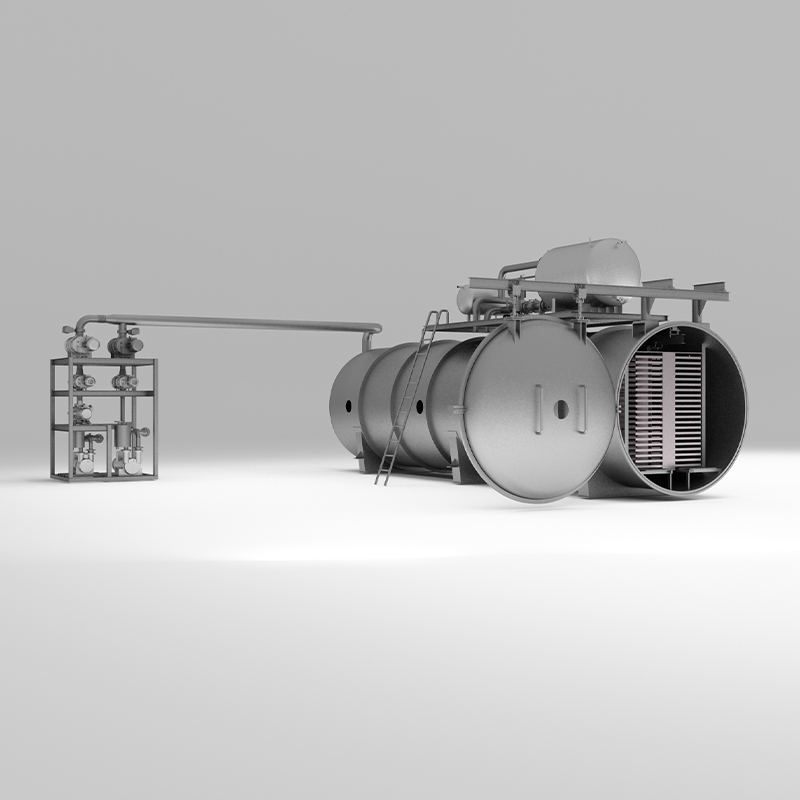 Fruit and Vegetable Vacuum Freeze Dryer for Process DevelopmentThis freeze dryer preserves color, flavor, and nutrition in fruits and vegetables, supporting both small trials and industrial production. Useful for optimizing food drying.View Product →
Vacuum pressure can be displayed in several units. You may find one gauge showing mbar, another showing mTorr, and a manual referring to microns. They all describe the same thing, just with different scales.
For freeze drying, the most useful measurement is the pressure inside the drying chamber, not the ultimate pressure at the vacuum pump. A pump might be capable of reaching 0.01 mbar, but the chamber pressure will be higher because water vapor is constantly entering the space from the product. Install the vacuum gauge near the chamber, or use a capacitive manometer that is not affected by the composition of the gas.
There is no single vacuum number that works for every material. The right setpoint is one that keeps the ice temperature safely below the product’s collapse or eutectic temperature while still allowing a reasonable sublimation rate.
Product formulation matters just as much as pressure. We often run small-batch trials before locking in a cycle. A focused lyophilization recipe development step can reveal whether your product needs a deeper vacuum or simply a slower heating profile.
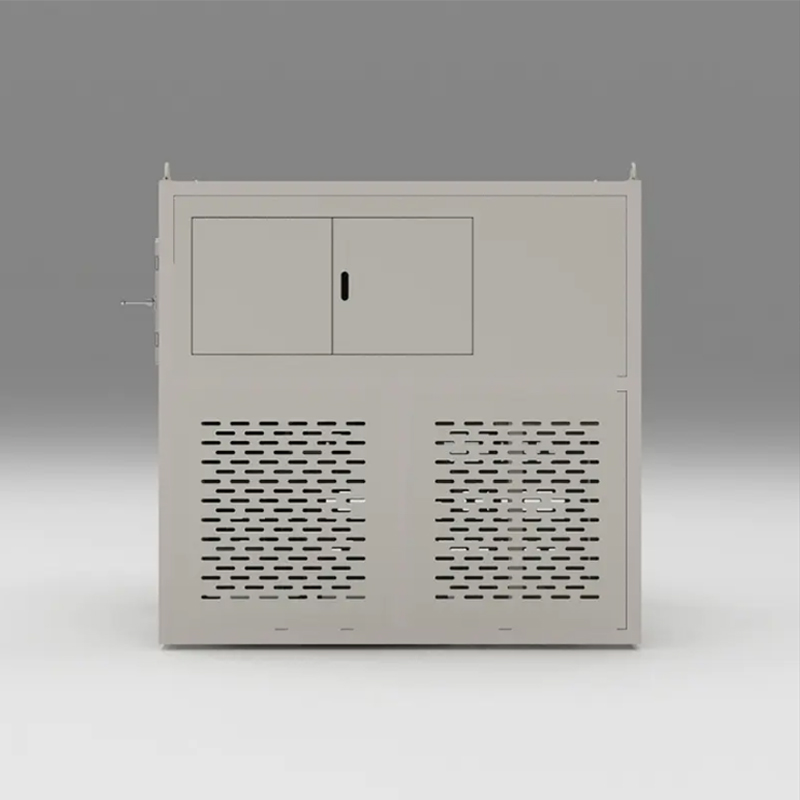 1-Square-Meter Laboratory Freeze Dryer for Recipe TrialsA lab-scale unit with precise chamber pressure control helps test formulations and vacuum levels before scaling up. Ideal for developing lyophilization cycles.View Product →
If you do not have a way to test different pressures precisely, a laboratory-scale freeze dryer with chamber pressure control is a practical tool for those trials.
Many operators ask about vacuum because they see a gauge reading that will not stabilize. In freeze drying, pressure fluctuations are usually a sign that vapor flow is being blocked or the condenser is overloaded.
The vacuum pump removes noncondensable gases, but the cold condenser does most of the water vapor work. If the condenser temperature is too warm, the water vapor pressure inside the chamber stays high no matter how long the pump runs.
The vacuum range does not change dramatically when you scale up, but equipment behavior does. In a pilot freeze dryer, the small chamber lets you reach the target pressure quickly. In a larger system, the condenser surface area, shelf size, and vacuum pump capacity all influence how well the chamber holds its setpoint.
When moving to production, choose a freeze dryer that can maintain the required pressure while handling the actual water load. An oversized pump is less useful than a properly sized ice condenser and a well-designed vapor pathway. For high-throughput food or ingredient processing, industrial-scale freeze dryers are built with exactly these factors in mind.
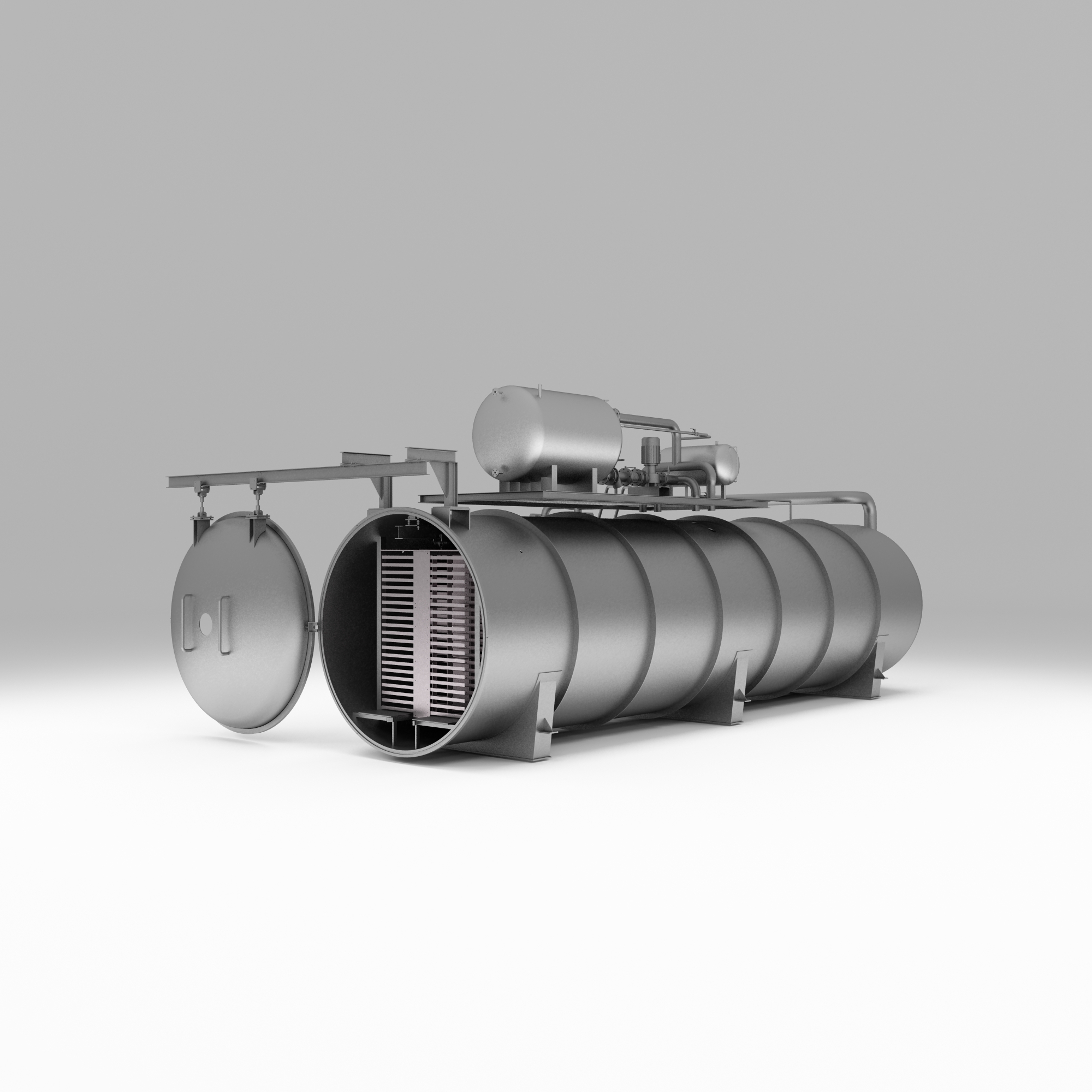 1200kg Industrial Freeze Dryer for High-Volume ProcessingDesigned for large-scale food, pet treat, and pharmaceutical production, this unit handles substantial water loads while maintaining pressure. Explore for production needs.View Product →
At Sieno, we monitor shelf temperature, product temperature, condenser load, and chamber pressure together. A vacuum gauge is only one part of the control loop, but it is a critical one.
If you only need a starting point, set the chamber pressure to about 0.15 mbar for a first trial and adjust from there. But the better long-term approach is to treat vacuum as one part of a triangle that also includes temperature and time. A well-designed cycle keeps the ice front moving at a steady pace, keeps the product structure intact, and delivers the residual moisture you need for shelf stability.
Before changing vacuum settings, ask what the product temperature is doing and whether the condenser is keeping up. With the right equipment and a little process development, “how much vacuum do I need?” becomes a much easier question to answer.


Sieno's whole series of freeze-drying equipment, covering the experimental research to the industrial scale, is energy efficient, stable, and reliable, with flexible customization as the core, to production, optimization of process, and multiple fields with green manufacturing solutions.
Sieno, based on the research of intelligent freeze-dried food, provides with custom process for the whole chain of freeze-dried technology support (including pretreatment, freeze-dried, and packaging), helping enterprises realize multiple improvements in efficiency, quality, and environmental protection.
Equiment & Soiution
Food Industry Pharmaceuticals Industry Agricultural Industry Pet Industry Beauty Care Industry Chemical Engineering & Laboratory Environmental Protection & Circular EconomyContact Info.
 +86 18068757376
 blk@jsblk.com
 Zhenglu Town, Tianning District, Changzhou City, Jiangsu Province, China
Follow Us
Copyright ©
Sieno Freeze-drying Technology Research Institute (Jiangsu) Co., Ltd
All Rights
Reserved
Custom One-Stop Freeze Drying Equipment Suppliers