
 English
 русский
 中文简体



-
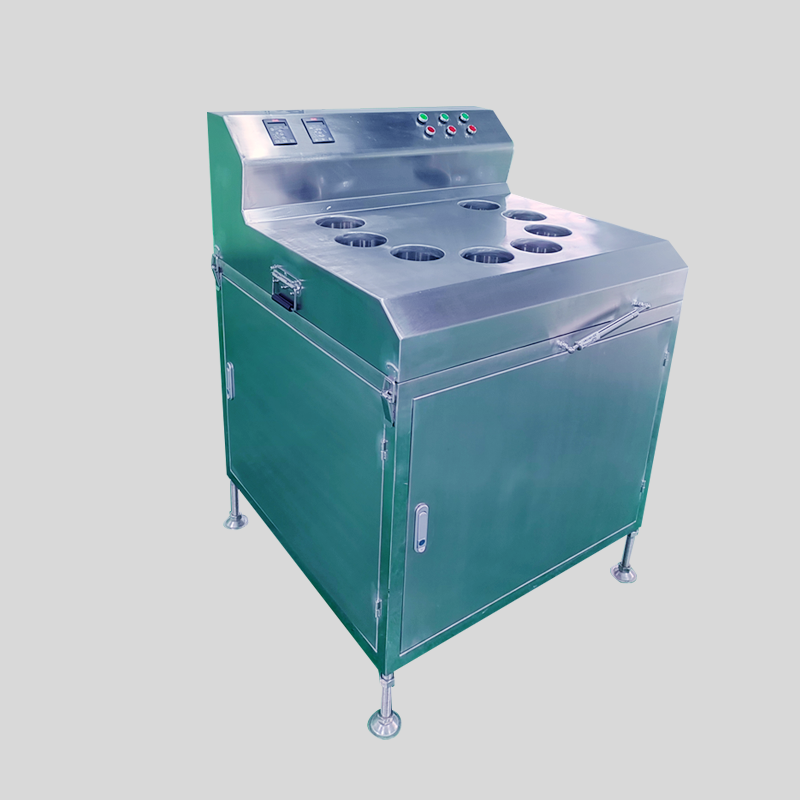
Multifunctional Vegetable Cutter for Instant Meals
Functional Introduction:
Standardized equipment for precise cutting of vegetables, mushrooms, and meat. It supports dicing, slicing, and strip cutting on a single platform with accuracy up to ±0.5 mm. Designed for front-end processing of frozen prepared dishes — risotto, stewed soup, instant cuisine — where cut specification determines cooking behavior, rehydration, and visual consistency.
Why cutting accuracy is a process-control variable
In instant meals built around freeze-dried or frozen components, cut size sets downstream behavior. An oversize dice rehydrates more slowly; an undersize dice turns to mush. A mushroom slice of uneven thickness cooks unevenly; a beef dice outside the declared range changes the protein-to-starch ratio. The ±0.5 mm tolerance keeps the recipe behaving as formulated, batch after batch. On multi-SKU lines, the cutter is also where changeover discipline is tested: the same machine must return to the same cut dimension when the product switches.
Performance data
- Cutting accuracy: up to ±5 mm, with thickness adjustment in 0.5 mm increments; dice sizes commonly 6, 8, 10, 12, 15, 20, and 25 mm; slice and strip adjustable on the same platform.
- Throughput: 300–1,000 kg/h depending on product form and cut type, covering medium and large frozen prepared-dish lines. Leafy and root vegetables run on dedicated cutting heads without changing the base machine.
- Material compatibility: fresh and blanched vegetables (carrot, potato, onion, cabbage, pepper, mushroom), meat dices for fillings, and mixed-ingredient formats cut on the same line.
- Cut geometries: dice, slice, strip, shred, and segment, with the profile defined by the cutting head rather than operator technique — output dimension is a machine setting, not a skill.
- Changeover: cutting-head and grid replacement for format switches, without re-calibrating the entire feed system.
Standardization: what it changes
A prepared-dish line buys a cutter not for throughput alone but because it is where “approximately diced” becomes “diced to specification.” Upstream, cutting dimension constrains blanching time, freezing rate, and drying behavior; downstream, it determines fill weight distribution. When the cutter holds ±0.5 mm, blanching and freezing profiles can be fixed rather than adjusted per batch, and the meal can be portioned against a declared ingredient ratio. The ingredient’s physical dimension becomes a controlled parameter, not an outcome.
Usage Scenario:
Preparation of ready-to-eat ingredients such as freeze-dried assorted vegetables, mushrooms, and diced beef. The cutter sits at raw-material preparation, ahead of blanching, cooking, freezing, or freeze-drying. Meets standard cutting requirements for family, outdoor, and military rations — formats where the cut must survive rehydration and remain recognizable. In military and outdoor rations, cut size is tied to reconstitution time; an out-of-tolerance dice can mean the difference between a meal that rehydrates in the stated time and one that does not.
Case reference: a leading vegetable processing enterprise in Shandong, China

Bolaike supplied this cutter to a leading Shandong vegetable processing enterprise for its export-oriented dehydrated and quick-frozen lines. The customer is a national-level agricultural industrialization key enterprise with standardized planting bases exceeding 35,000 mu and a processing park over 350,000 m². Its portfolio covers fresh-keeping, dehydrated, quick-frozen, and seasoned vegetables, supplying McCormick, Nestlé, and Unilever, with exports to Europe, North America, Japan, South Korea, and Southeast Asia.
The requirement arose from a move from multiple stand-alone cutters to a standardized front-end preparation line for instant-meal and ready-to-eat ingredient customers, including freeze-dried assorted vegetables, mushroom dices, and diced beef — formats requiring the cut dimension to hold across vegetable and meat inputs on the same line. The previous setup used separate machines per material and format, causing dimensional drift between batches and operator-dependent changeover. The cutter was specified to bring dicing, slicing, and strip cutting onto one platform, with ±0.5 mm as the acceptance criterion and throughput matched to the dehydration and quick-freezing lines.
The measurable result is a cutting stage scheduled against a fixed specification rather than adjusted to the previous machine’s output. The cut dimension entering the dryer or freezer is now a controlled parameter, stabilizing rehydration behavior and reducing re-sorting or re-processing of out-of-range batches. For export buyers auditing ingredient specifications, the cutter’s standardized output becomes part of the batch documentation rather than a variable to explain after the fact.

Request a Quote




 yuanliang@jsblk.com
 No.29 Tongiiang North Road, Xinbei District, Changzhou City, Jiangsu, China
