English
 русский
 中文简体

Request a Quote

Industry News
 Home / Recent News / Industry News / How to Store Freeze-Dried Breast Milk: Temperature, Packaging, Shelf Life
 2026.11.09
 Industry News
If you have ever poured a bag of thawed breast milk down the sink because it smelled off, you already understand why freeze-drying appeals to pumping parents. Removing the water from expressed milk turns a fragile liquid with a short fridge life into a light powder you can stack in a cupboard, tuck into a diaper bag, or hand to a caregiver. But the powder is only as good as the way you keep it. Get the storage step wrong, and you lose exactly the thing you were trying to protect.
What follows is a practical walkthrough of how to store freeze-dried breast milk: how dry the powder needs to be before it is sealed, which containers genuinely hold up, what temperatures make sense, and how long a batch will realistically last.
Freeze-drying, or lyophilization, freezes the milk first and then removes the water as vapour under vacuum. Because the ice turns directly into vapour rather than melting and boiling away, the fat, protein and sugars are left largely in place, and the finished material comes out as a brittle powder or delicate flake rather than a cooked-on residue.
That porous structure is why the powder rehydrates so quickly — and also why it grabs moisture from the air with almost alarming enthusiasm. A scoop left open on the counter on a humid afternoon will start clumping within minutes. The same low-temperature principle sits behind nutritional retention technology in food manufacturing, where the aim is to keep heat-sensitive components close to their original state. All of that effort is undone by a bag that breathes or a jar lid that does not seal.
Storage begins before the lid goes on. Run through these three checks every time you finish a batch.
Light and moisture are the two things that shorten shelf life fastest, so the container needs to block both. In practice, the reliable options are opaque, high-barrier pouches or bags with a good heat seal, small glass jars with fresh sealing lids, and vacuum-sealed portions. Adding an oxygen absorber to a sealed pouch helps further if you plan to keep a batch for many months.
Avoid thin zip-top bags not designed for long-term storage, clear containers left on an open shelf, and any tub that previously held something strongly scented — the powder picks up odours readily. If you eventually move from kitchen-scale batches to packing larger volumes, the same logic used in freeze-dried food packaging lines applies at home: seal integrity and moisture barrier matter far more than a pretty label.
There is no official published shelf-life standard for home freeze-dried breast milk, so treat the ranges below as conservative guidance rather than a guarantee. Cooler, darker and drier is always better, and every time a container is opened the clock effectively restarts a little.
| Storage location | Typical temperature | Realistic window | Notes |
|---|---|---|---|
| Dark cupboard or pantry | Up to 25°C / 77°F | 6 to 12 months | Best for everyday rotation; keep away from the stove and kettle |
| Cool basement or cellar | 10 to 15°C / 50 to 59°F | 12 to 18 months | Ideal if humidity stays low year-round |
| Refrigerator | 2 to 4°C / 36 to 39°F | 12 to 24 months | Only in fully sealed portions; condensation on opening is the enemy |
| Freezer | -18°C / 0°F or colder | 18 months and beyond | Not required for a dry powder; thaw sealed and let it reach room temperature before opening |
Write on the container before the powder goes in, not afterwards, when your hands are full. A useful label carries the date of drying, the volume of fresh milk that went into the batch, and any note that might matter later — for example whether you had eaten something unusual or taken a medication. Rotate oldest to the front and use first, the way you would with any pantry stock.
If a batch is split across several pouches, number them. That way a single suspicious pouch does not condemn the whole session's work.
Reconstitution is where careful storage pays off, and where careless handling can undo it. Work cleanly and keep the steps boring.
The real advantage of a dry powder shows up away from home. Small sealed single-serve pouches fit into a carry-on without triggering liquid limits in most cases, weigh almost nothing, and do not need a cooler. For a caregiver or a daycare handover, a labelled pouch plus clear rehydration instructions removes most of the guesswork. Just keep the pouches out of a hot car and away from a leaking water bottle in the same bag.
Home freeze-drying is usually done on a benchtop unit, and the results depend heavily on how well the machine holds vacuum and controls shelf temperature. Compact laboratory-scale machines such as the
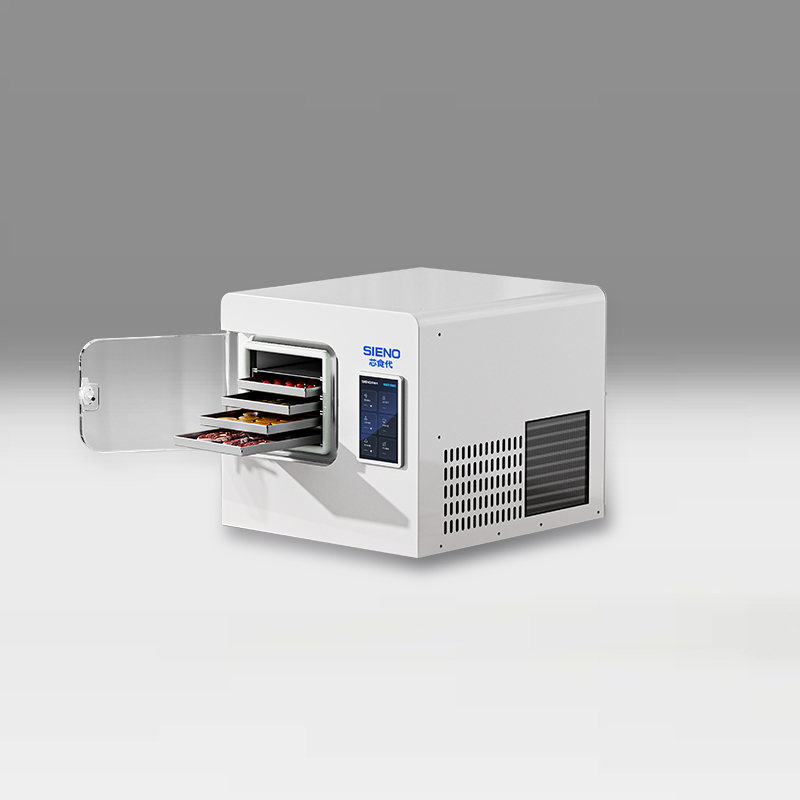 XSD-FD-4 Compact Laboratory Freeze DryerA compact laboratory-scale freeze dryer listed within Sieno’s customized solutions, suited to benchtop work where repeatable batches matter more than one-off experiments.View Product →
are built around that same balance of chamber size, condenser capacity and stable programming, which is why they are often the first step for anyone who wants repeatable batches rather than one-off experiments.
The engineering questions do not change when volume grows — they just get more expensive to get wrong. For milk and other liquid bases with high fat and solids content, a machine configured for the way dairy behaves during freezing and sublimation makes far more sense than a general-purpose chamber pushed beyond its comfort zone; that is the thinking behind the
 Vacuum Freeze Dryer for Dairy ProductsA dairy-specific vacuum freeze dryer for milk, yogurt, whey and other bases, using controlled sublimation to help retain protein, fat and flavor.View Product →
. Sieno builds equipment across that whole span, from lab units to industrial systems, and spends most of its time on the parts nobody photographs: cycle profiles, sealing, and how a batch is handled after the door opens.
Freeze-drying does not sterilise milk, and home-dried powder is not a regulated infant product. Treat stored powder as you would any carefully handled raw food: keep it dry, keep it cool, keep it labelled, and discard anything that smells sour, looks discoloured, or has clearly taken on moisture. Introduce stored milk the way you would introduce anything new to a baby's diet, and check with your paediatrician or a lactation consultant if you are unsure about a batch, a medication, or how your baby is responding.
Done properly, storage is the least glamorous and most valuable part of the whole process. A dry powder, a sealed opaque pouch, a cool dark shelf and an honest date on the label will protect months of effort — no special equipment required.


Sieno's whole series of freeze-drying equipment, covering the experimental research to the industrial scale, is energy efficient, stable, and reliable, with flexible customization as the core, to production, optimization of process, and multiple fields with green manufacturing solutions.
Sieno, based on the research of intelligent freeze-dried food, provides with custom process for the whole chain of freeze-dried technology support (including pretreatment, freeze-dried, and packaging), helping enterprises realize multiple improvements in efficiency, quality, and environmental protection.
Equiment & Soiution
Food Industry Pharmaceuticals Industry Agricultural Industry Pet Industry Beauty Care Industry Chemical Engineering & Laboratory Environmental Protection & Circular EconomyContact Info.
 Sales counsltant: +86 17312896506
WhatsApp: +8617312896506
 yuanliang@jsblk.com
 No.29 Tongiiang North Road, Xinbei District, Changzhou City, Jiangsu, China
Follow Us
Copyright ©
Sieno Freeze-drying Technology Research Institute (Jiangsu) Co., Ltd
All Rights
Reserved
Custom One-Stop Freeze Drying Equipment Suppliers